Interior advertising and indoor branding
POS materials
Shelf talkers, wobblers, displays and promo counters — advertising a step from where the decision happens.
At a glance
- Runs from a few to thousands
- Card, plastic or metal
- Assembled without tools
- One look across the chain
About this solution
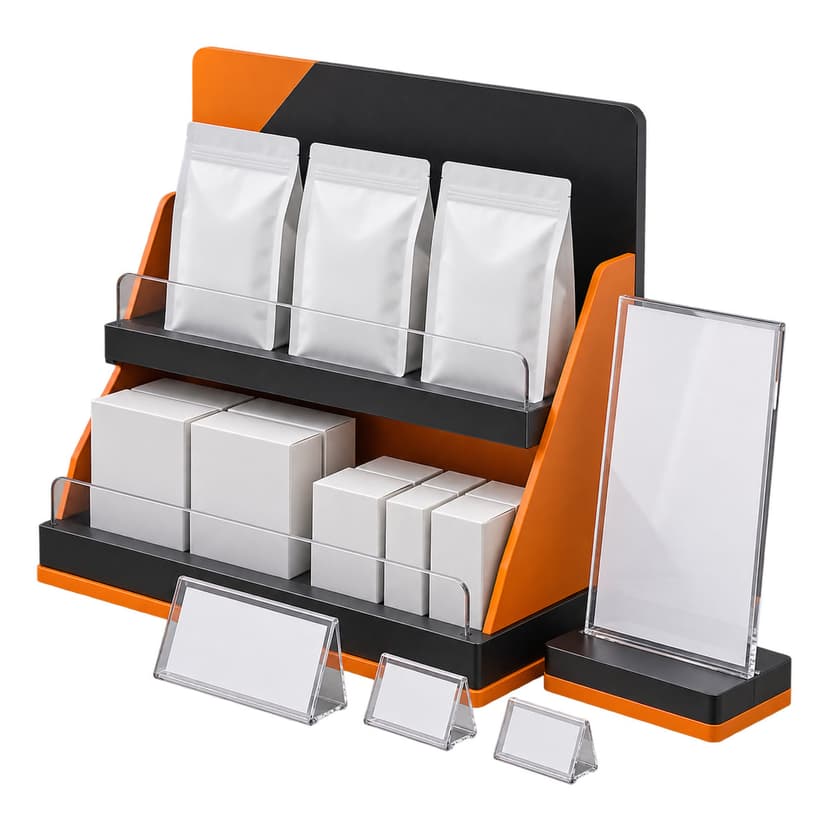
POS materials are advertising at the point of sale: the product stand by the till, the menu holder on the table, the price holder on the shelf, the counter display with leaflets, the clear stand with the day's offer. They are the smallest objects in all of a company's advertising and the ones the customer touches — which is why a crooked or scratched holder shows more than a well-made lit sign.
They are made from clear or coloured acrylic, hot-bent and bonded, from PVC and polystyrene, from printed corrugated or solid board, from painted sheet or wire, depending on how much they have to hold and how long they have to last. Acrylic for menu holders, price holders and counter displays that stay in the shop for months; board for campaigns of a few weeks, in large runs, delivered flat and assembled on the spot without tools; metal for product stands that carry weight. Graphics are printed directly on the material, applied in vinyl or changed as an insert.
What separates good POS from poor shows in the shop, not on the drawing: a holder that stands straight on a table that is not, a board stand that survives the tenth restocking, a price holder in which the label changes in a second. A prototype is made before the run, the real product is put on it, and only then is the series produced.
For a chain of shops or restaurants POS materials are designed as a family: the same style, the same colours, the same formats, from the stand at the entrance to the holder on the table, and delivered in the right number for each location. Send us what product has to be shown, where — shelf, counter, table, floor — and how many pieces, and we propose the shape and the material.
Frequently asked questions
All frequently asked questionsAcrylic, card or metal?
Acrylic for what stays in the shop for months and is seen up close: menu holders, price holders, counter displays. Printed card for short campaigns and large runs — delivered flat, assembled on the spot and thrown away at the end. Metal for product stands that carry weight or stand on the floor. They are often combined: a metal structure, changeable card graphics.
What is the minimum run?
There is no fixed one: we make a single piece — a menu holder for a restaurant, a display for a reception — and thousands, for a chain or a national campaign. What differs is the method: one piece is made by hand in acrylic, a thousand with tooling or die-cut from card. Tell us the number and we choose the way to produce it.
Can I see a sample before the run?
Yes, and we recommend it: the prototype is made in the final material, the real product is put on it, and only then is the series produced. The prototype shows what the drawing does not — whether it stands straight, whether the product fits, whether the label changes easily. Corrections on a prototype are simple; on a run they are not.
What should I send for a quote?
What product has to be shown — with its size and a photograph — where the holder goes (shelf, counter, table, floor), how many pieces and for how long. The brand's logo and colours, if there are any. A photograph of something similar you like helps settle the shape.
Send a request
Your project starts here.
Tell us what you need, and we’ll put together a tailored quote.