Interior advertising and indoor branding
Wayfinding signs
A signage system that gets a visitor to the right door without asking anyone.
At a glance
- One system for the whole building
- Swappable name inserts
- Tactile and Braille options
- Floor plans and directories
About this solution
Wayfinding is the signage nobody notices when it is done well: the arrow at the car park entrance, the floor directory in the lobby, the plaque on a consulting-room door, the pictogram by the toilets. In a shopping centre, a clinic, a public institution or an office building, it decides whether a person gets where they meant to go without asking. It is not a collection of plaques but a system: the same letters, the same colours, the same shapes from the gate to the door.
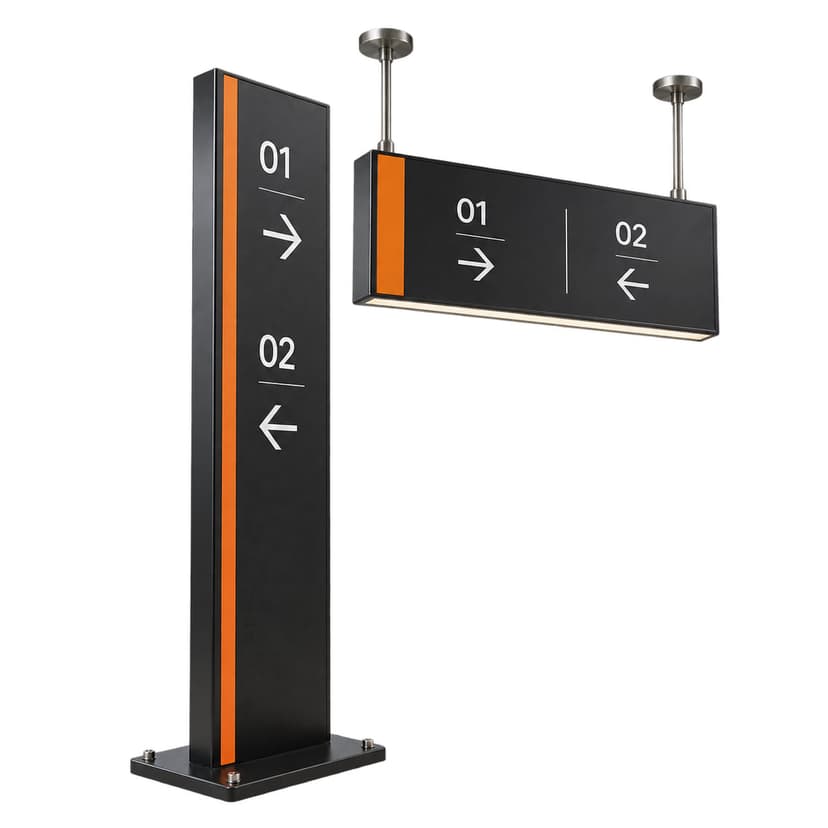
Outside — at entrances, car parks, internal roads and across the buildings of a campus — signs are made from composite aluminium or painted sheet, on their own structure or on a post, with lettering in UV-resistant vinyl or applied letters, lit where they are read at night. Inside, the materials are acrylic, aluminium, PVC and, where the interior asks for it, wood or glass: panels hung from the ceiling along wide corridors, wall plaques beside doors, floor-standing totems in lobbies and at junctions, floor plans at lifts and stairs. Door plaques are made with swappable inserts — paper or film under an acrylic cover — so a name changes without changing the plaque. For public buildings there are tactile and Braille versions.
A good system is recognised by what it does not need: someone at reception explaining the way. It comes from simple things, kept to everywhere: letters large enough for the distance they are read from, contrast between text and ground, one style of arrow, pictograms understood without words, and the same position on the wall throughout the building. The usual mistake is too many messages on one panel; the second is putting the panel where there is room rather than where the person makes the decision.
That is why a system is planned before it is made: the routes are walked on the plan — from the car park to reception, from reception to every destination — every point where someone has to choose is marked, and at each one it is decided what kind of sign stands there, at what size and with what message. The list of pieces comes out of that plan, not the other way round. Fixing is to wall, ceiling, glass or floor depending on the piece, and a well-planned system leaves room for the changes that come later — a new tenant, a department that moves — without redoing everything.
Frequently asked questions
All frequently asked questionsWhere does a wayfinding system start?
With the plan of the building, not with the plaques. The routes people take are walked through — from the car park to the entrance, from reception to every destination — and the places where someone has to choose are marked. A sign stands at each; the rest is a list of pieces. If you have the plans and a brand manual, send them; if not, we start with a visit.
What are the signs made of?
Inside, acrylic, aluminium and PVC, with lettering in cut vinyl, print or applied letters; outside, composite aluminium or painted sheet, on their own structure or on a post, with UV-resistant graphics. For public buildings there are tactile versions, with relief and Braille. The material is chosen by the place and by how often the message changes.
What happens when a name or a tenant changes?
Door plaques and directory panels are made with swappable inserts: paper or film under an acrylic cover that comes off without tools. The name changes on the spot, the plaque stays. On large panels the graphics are layered — a permanent ground, the text on film — so a change does not mean a new panel.
Can it be done for an existing building, with old plaques?
Yes, and it is the most common case. What is there is surveyed, what works is kept, and what is missing or contradicts the rest is replaced, in one style. A new system does not have to mean everything new: it means that from the gate to the door the same letters, colours and arrows are seen.
Send a request
Your project starts here.
Tell us what you need, and we’ll put together a tailored quote.