Interior advertising and indoor branding
Window and glass graphics
A shop window is advertising space you already own. We turn it into space that sells.
At a glance
- Frosted and decorative films
- Seasonal changeovers
- Partly transparent print
- Bubble-free application
About this solution
The shop window is the largest advertising surface a shop has and, most of the time, the least used: bare glass with a shelf behind it. Dressing it with film turns it into a poster, a wall or a filter as needed — a seasonal message, a backdrop for the goods on show, privacy for a clinic or a ground-floor office, less sun in a café that faces south.
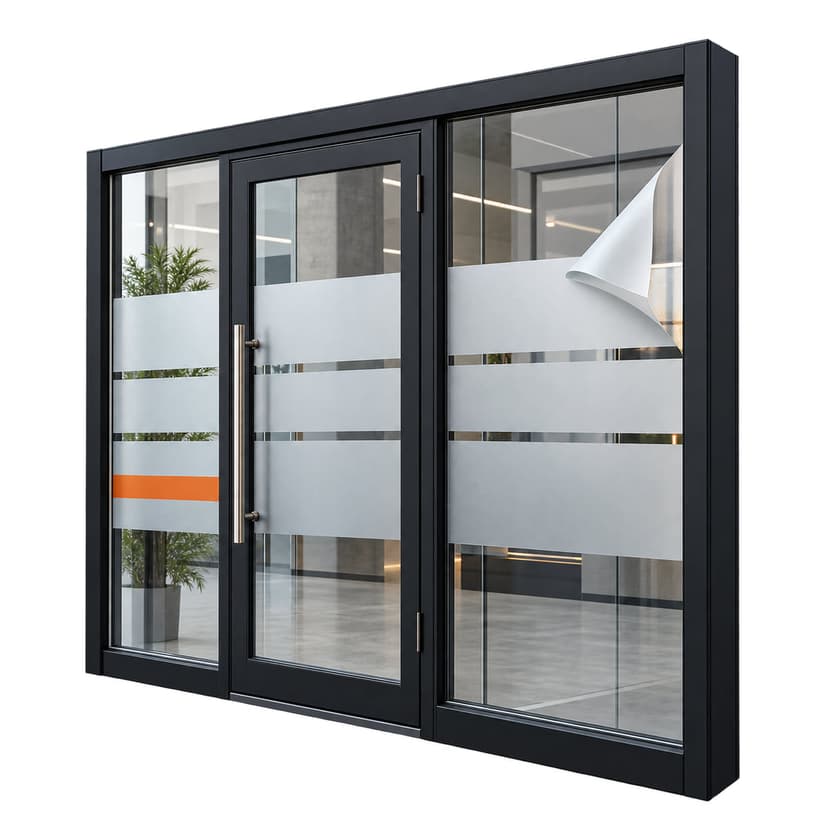
Films come in several kinds and do different things. Frosted film gives the glass the look of etched glass: it keeps the light, hides the interior, and letters and bands are cut out of it so the frosted and the clear parts draw together. Coloured films, matt or gloss, are plotter-cut to the logo and text. Perforated film is printed with a whole image seen from outside, while from inside the street stays visible. Tinting film cuts heat and glare without changing the look. And partly transparent print — on clear film, with white under the colour only where it is needed — leaves the artwork floating on the glass.
What shows on a badly done window is bubbles, dust trapped under the film and crooked joins between two strips. They are avoided by wet application, on glass cleaned on both sides, with the film set by level and trimmed at the edge in place; on large panes the strips meet at a point chosen so the join is not seen. Films usually go on the inside, away from rain and scratches, with the artwork reversed so it reads from the street.
A window display is not for ever and need not be: removable films come off clean at the change of season or campaign, and the glass is as it was. A chain store changes its windows a few times a year; a clinic keeps its frosted film for years. Say how long it has to last, and the film is chosen for that.
Frequently asked questions
All frequently asked questionsFrosted film or tinting film?
Frosted when you want to hide the interior while keeping the light — a clinic, an office, a ground-floor meeting room — or when you want a matt design on the glass. Tinting when the problem is the sun: it cuts heat and glare but leaves the glass clear and does not read as decoration. They can be combined: a frosted band at eye level on tinted glass.
Can you see out through perforated film?
From outside you see the printed image, like a whole poster; from inside you see the street through the film's holes, slightly darkened, as through smoked glass. It works as long as it is brighter outside than in — in the evening, with the shop lights on, the effect partly reverses. For windows that must stay clear at night too, a different film is chosen.
Can the display change every season?
Yes, and removable films are used for that: they come off clean and leave no adhesive. Seasonal graphics are usually on printed or coloured cut film, and the permanent elements — the logo, the opening hours — on long-life film, so they are not redone each time. If the changes are frequent, a full-size template of the window saves time on every round.
What should I send for a quote?
A photograph of the window from the street, the size of each pane — width and height — what has to appear on them and what the film has to do: decorate, hide, shade. If there is a campaign design, so much the better. From those follow the type of film and the area.
Send a request
Your project starts here.
Tell us what you need, and we’ll put together a tailored quote.