Outdoor advertising
Pseudo-3D letters
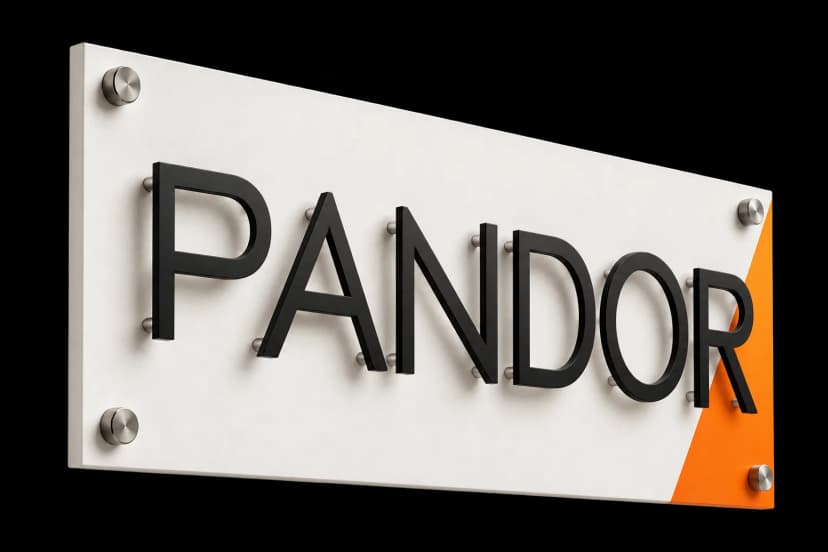
Flat letters with a returned edge: the look of depth at a lower weight and cost.
At a glance
- Lightweight build
- Quick turnaround
- Crisp, fine linework
- Budget-friendly
About this solution
A flat-cut, pseudo-3D letter is cut from a thin sheet — a few millimetres — and held off the wall so that its shadow does the rest. From a metre away it looks like a 3D letter; in the hand it weighs as much as a piece of card. It is the answer for reception walls, offices, shop windows and small signs, where a letter with a full body would be too heavy or too bulky for what it has to do.
They are cut on a CNC router or a laser from acrylic, foamed PVC or MDF, three to ten millimetres thick. Acrylic comes coloured all the way through, clear, mirrored or matt; PVC is painted; MDF is spray-painted in a booth and lacquered for a surface as smooth as furniture, or left with its own grain where the interior calls for wood. The face can take a textured vinyl — brushed metal, wood, carbon — giving the letter a material the sheet does not have.
What matters in a thin letter is flatness: a sheet a few millimetres thick bows if it is fixed at too few points or the material is wrong for the setting. MDF stays indoors, because it takes up water; outdoors it is acrylic and PVC. The cut edge is finished — on acrylic, flame- or diamond-polished — because on a thin letter it is nearly all you see in profile.
Fixing is on short standoffs, holding the letter one or two centimetres off the wall and letting light pass behind it, or by direct bonding, for small letters and for glass. Holes are drilled from a full-size template so the letters land aligned; on an uneven surface the letters go on a backing panel that gives them a flat base.
Frequently asked questions
All frequently asked questionsHow are they different from 3D letters?
Thickness. A 3D letter has a body with returns several centimetres deep; a flat-cut letter is cut from a sheet three to ten millimetres thick and held off the wall, and the shadow does the rest. It reads the same from a metre away, weighs several times less and is simpler to make. It cannot be lit from inside.
Acrylic, PVC or MDF?
Acrylic when colour all the way through, transparency or a glossy edge is wanted — and outdoors. PVC for painted, light and economical letters, inside and out. MDF indoors only: for a smooth, spray-painted surface, or for the wood grain the interior calls for.
Can they go on glass or plasterboard?
Yes — it is one of the reasons they are chosen. Being light, they bond directly to glass, tiles or a painted wall, and on plasterboard they go on standoffs with the right plugs, with no extra structure. On an uneven surface they go on a backing panel that gives them a flat base.
What should I send for a quote?
The text or logo, ideally as a vector file, the overall width it has to fill, a photograph of the wall, and whether it goes inside or outside. From those follow the material, the thickness and the fixing.
Send a request
Your project starts here.
Tell us what you need, and we’ll put together a tailored quote.