Outdoor advertising
Street furniture and small architectural forms
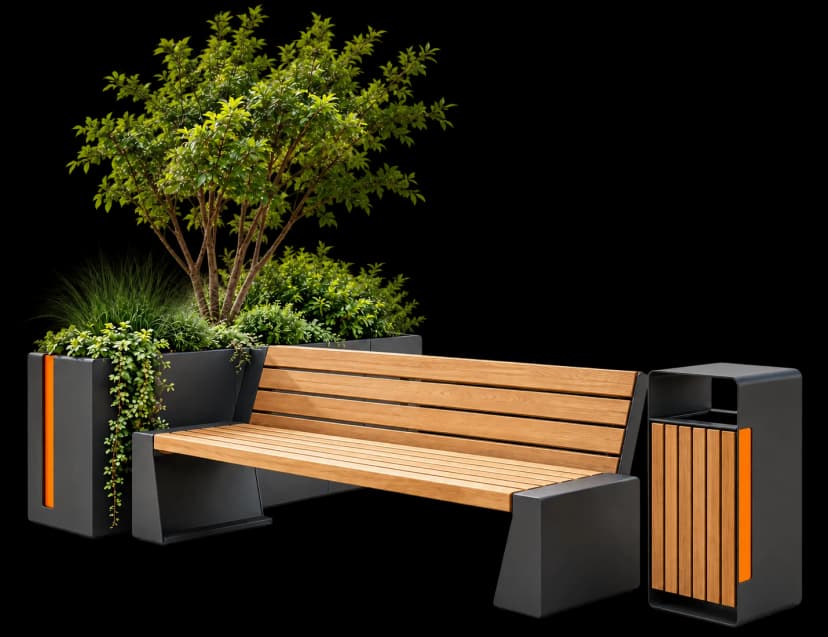
Benches, bins, railings and wayfinding for public space — sturdy, tidy, all of a piece.
At a glance
- Anti-vandal construction
- One style across the site
- Weatherproof finishes
- Installed on location
About this solution
Street furniture is advertising that has become part of the city: the bus shelter with a lightbox in its wall, the sign at the entrance to a residential estate, the bench and planter in front of a shopping centre, the flagpoles at a factory gate, the bicycle rack with the company's logo. For a developer, a town hall, a campus or a retail park these objects decide whether the space looks like a place that was thought about or like a car park.
They are made from powder-coated or galvanised steel, stainless steel, composite aluminium, timber treated for outdoors and toughened glass, depending on the object and the place. Bus shelters have a steel frame, a polycarbonate or metal roof, glass walls and one or more lightboxes for advertising with their own power supply. Urban signs and wayfinding follow the same principles as a building's signage, but at street scale and in materials that stand outdoors for years. Benches, planters and racks are drawn in the same style, so the whole area reads as one project.
What matters in a street object is that it stands in rain and frost, within anyone's reach, day and night. So the construction is anti-vandal: fixings that do not come undone with an ordinary screwdriver, surfaces graffiti washes off, glass that does not shatter into shards, foundations or anchors that do not let the object be moved. Paint and materials are chosen for sun and road salt, or the first tired-looking object spoils the impression of the whole area.
The job starts from the plan of the area and its style — the developer's brand manual or the architecture of the place — and arrives at a family of objects in one language: the same colours, the same profiles, the same letters. They are installed on site, on poured foundations or on anchors in the paving, with power brought in where the object lights up. For a new area everything is made at once; for an existing one, object by object, in the style of what is there.
Frequently asked questions
All frequently asked questionsWhat counts as street furniture?
Everything that stands outside, on the ground, and carries a place's identity: bus shelters with advertising, wayfinding signs and totems, entrance panels for estates and parks, benches, planters, bins, bicycle racks, flagpoles and flags, lighting columns with advertising arms. We make them as a family, in one style, or as single objects in the style of what is there.
Are they vandal-resistant?
They are made for it: fixings that do not come undone with ordinary tools, surfaces graffiti washes off, toughened glass or polycarbonate instead of ordinary glass, anchors or foundations that do not let the object be moved. Nothing is indestructible, but a well-made object takes more effort than it is worth, and a broken part is replaced on its own, not the whole object.
Can they be made in the estate's or the brand's style?
Yes, and they should be: we start from the developer's brand manual or from the architecture of the place — colours, materials, shapes — and draw every object in the same language, so the shelter, the signs and the benches read together. For an existing area the new objects are made in the style of the earlier ones, so it does not show that they came later.
What should I send for a quote?
The plan of the area or a photograph of the place, the list of objects you need — how many shelters, how many signs, how many benches — and the brand manual or photographs of the style wanted. If there is a landscaping design, send it. From those follow the family of objects and the materials; the rest is measured on site.
Send a request
Your project starts here.
Tell us what you need, and we’ll put together a tailored quote.