Outdoor advertising
Projecting bracket signs
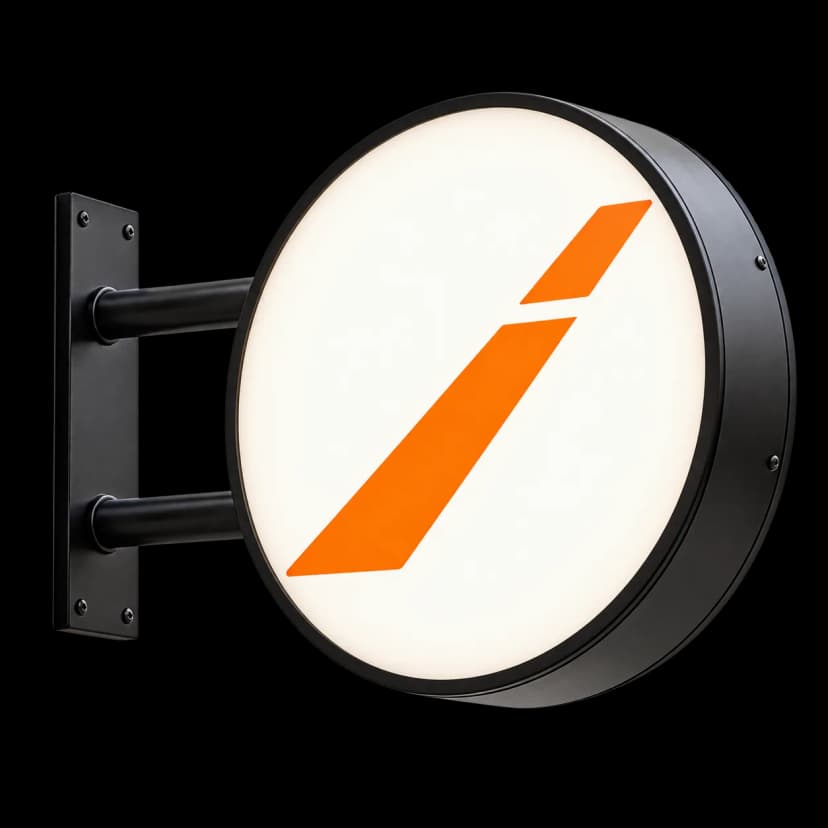
Boxes set at right angles to the facade — seen down the street, not only from the doorway.
At a glance
- Visible along the street
- Lit on both faces
- Bracket matched to the facade
- Compact structure
About this solution
A projecting sign is the one read along the street rather than from in front of it: mounted perpendicular to the facade, on a bracket, with two faces, it is seen by someone walking the pavement or driving the street long before they draw level with the entrance. For a pharmacy, a café or a shop on a street of signs side by side, it is often more useful than the box above the window, which only the person standing opposite sees.
It is built as a double-sided lightbox: a body in aluminium profile or PVC, faces in acrylic or polycarbonate with vinyl or printed graphics, LED modules between them, spaced so both faces light evenly. The shape can be rectangular, round, oval or cut to the logo; the unlit version is made in composite or PVC with applied graphics. The bracket is a steel structure of its own, painted, sized for the weight of the box, for how far it projects from the wall and for wind.
What separates a good one from a poor one is the bracket and the cable. The bracket must be anchored in the structure of the wall, not in render or in the facade's insulation, with anchors suited to the material — brick, concrete, composite on a subframe. The supply cable runs inside the bracket, not alongside it, and enters the building through a single sealed penetration. The box is built so water does not stay in it and so it can be opened for maintenance without being taken down.
It is mounted above the heads of people on the pavement, with its lower edge above head height, and at a distance from the facade that keeps it visible from both sides of the street. On a street with several signs, the same mounting height along the whole building makes each one read better. The bracket is painted the colour of the facade or the box, so it disappears, or made as a design element — wrought iron, a decorative arm — where the street calls for it.
Frequently asked questions
All frequently asked questionsLit or unlit projecting sign?
Lit if the business is open after dark or the street is poorly lit — an unlit projecting sign disappears completely at night. Unlit for an office, an institution or a shop with daytime hours, and where the facade cannot take a power supply. The unlit version can be lit from outside with a spotlight on the facade.
How big can a projecting sign be?
As big as the wall and the bracket will carry and the street allows: a box that projects too far over the pavement becomes a problem for lorries and for the neighbours. It is usually smaller than the box on the facade, because it is read up close, along the pavement. Tell us where it would go and we propose the size from a photograph.
Can it be mounted on an insulated facade?
Yes, but the bracket is not anchored in the polystyrene or the render over it: it passes through the insulation layer with long anchors or spacers into the load-bearing wall, and the penetration is sealed so water cannot get into the insulation. The same goes for facades clad in composite, where the bracket fixes to the subframe or the wall, not to the panel.
What should I send for a quote?
A photograph of the facade from the street, with the spot where the sign would go, the logo or text, whether it has to be lit and whether there is power nearby. From the photograph follow the right shape, size and kind of bracket; the wall material we check on site.
Send a request
Your project starts here.
Tell us what you need, and we’ll put together a tailored quote.